Constructivism and Religons
Constructivism is an approach that emphasizes the
recognition of relationships among subjects and between subjects and entities.
More specifically, it is an approach that emphasizes norms, ideas, and
identities in international relations, an approach that has been gaining ground
in international political science since around the 1990s.
Realism, in particular, has not emphasized religious aspects and factors, and
the realist approach seems powerless in the face of the anti-government movement sparked by
the death of Mahsa Animi and the sanctions imposed by Western nations against
it. During the Cold War, when the international order was built on the military
power of states and ideological conflicts, a realist approach based on thetheory that states would act rationally in an anarchic world was effective.
However, the development of information and communication technology and
changes in the media environment encouraged the increased role of public
opinion and the formation of a global civil society. This may have prompted the
emergence of an anti-government movement within Iran, which was triggered by
the death of Mahsa Animi. The changing media environment and
the strengthening of civil society can be seen as having an impact on the world
order and may increase the usefulness of a structuralist approach.
The anti-government movement triggered by the death of Mahsa Animi and the
reaction of Western countries to it have also persuaded the American political
scientist Samuel Huntington's "Clash of Civilizations". Samuel Huntington
argues that the main axis of international politics is shifting from the
conflict of military power and ideology during the Cold War to the conflict of
civilizations, cultures, and religions. The events in Iran can be seen as an
expression of the conflict between the West's values for human rights and
Iran's values as a nation.
It is also important to adopt religion as an important factor in the study of
international relations. As noted above, the strengthening of civil society,
due to changes in the media environment, has increased the role of public
opinion in political decision-making. Some developed countries are experiencing
declining birth-rates and an aging population to varying degrees, and some
countries are using immigration to finance their workforces. Japan, forexample, has a seriously aging population with a birth-rate below 800,000. In
contrast, many developing countries are experiencing population growth, and in
a sense, the population within the developed world is becoming even more of a
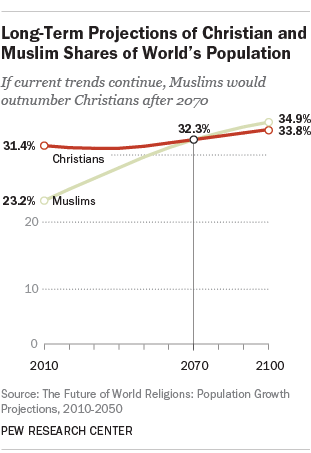
minority on a global scale. Christianity is widely practiced in Europe, despite
sectarian differences. However, Islam is predominant mainly in developing
countries, and its population is growing, with some studies showing that the
Christian and Muslim populations will be in competition around the year 2050.
While the impact of religion on politics is unknown, it will be interesting to
see how the changing composition of the world's religions will affect world
politics. It is predicted that a Constructivist approach that
emphasizes norms
and identity will become an effective approach because of these changes in the
structure of society.


コメント
コメントを投稿